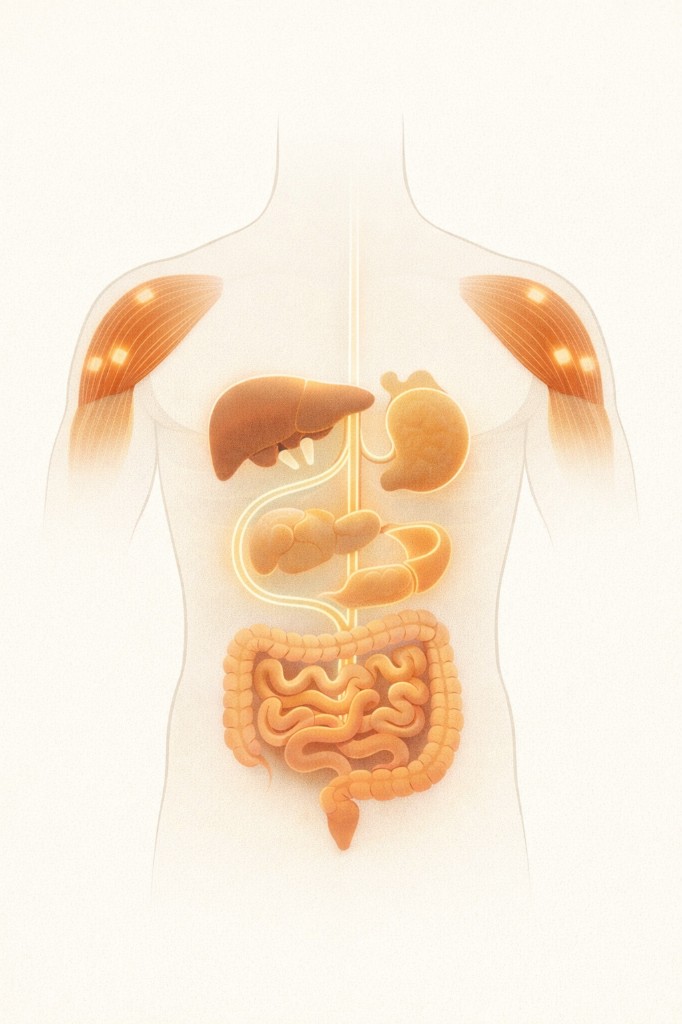
I come to health from a strange intersection. I've worked in the clinical research field for several years as a software engineer. I've been trained to think in systems: inputs, outputs, bottlenecks, failure modes. At the same time, I've been an athlete most of my life, and for the last decade I've been coached and coached bodies in the real world—not just on paper.
Somewhere along the way, bodybuilding became the lens that pulled all of that together.
Because bodybuilding, at its core, is not about lifting weights or eating chicken and rice. It's about surgically manipulating biological systems. It's about learning how the body responds to fuel, stress, recovery, and timing—then using that knowledge deliberately rather than reactively.
When you strip away the stereotypes, bodybuilding is applied physiology at its most extreme. And the deeper I went, the more I realized that the same systems we manipulate for aesthetics and performance are the exact systems that break down in metabolic disease. The difference isn't the system itself. It's control.
A Music Festival, Not a Meal Plan
To understand how these systems work together, I like to use a music festival analogy instead of the usual food metaphors. But before we walk into the festival, let's meet the players.
Glucose
The simplest form of sugar your body uses for energy. It's what's circulating in your blood right now, fueling everything from your brain to your biceps.
Glycogen
Glucose that's already been stored for later—packed into your muscles and liver like energy reserves your body can tap when it needs fuel fast.
Insulin
A hormone your pancreas releases to manage glucose. Its job is to signal your cells to open up and let glucose in.
Cortisol
Your stress hormone. It responds to training, under-eating, poor sleep, and anything your body reads as a threat.
Now picture a massive outdoor festival.
The festival grounds are your muscles and organs. The crowd is glucose. The space inside the gates is glycogen storage. The entry scanners and logistics system are insulin signaling. The festival staff and emergency services represent cortisol and stress responses.
When everything is working well, people arrive steadily. Tickets are scanned efficiently. The crowd flows in, fills the space, and the festival feels energetic but organized. That's metabolic health.
Glucose and Glycogen: The Crowd and the Capacity
Glucose is the most basic unit of usable energy circulating in your bloodstream. Glycogen is glucose that's already been admitted into the festival—think of it as glucose with a wristband. Glycogen is stored in muscle and liver for later use.
When glycogen storage is available, glucose has somewhere to go. Muscles look full, performance is high, and energy feels stable. But just like a music festival, glycogen space is limited.
If the venue is already near capacity, or if people arrive too fast, problems begin. Not because glucose is bad, but because rate matters more than quantity.
A slow, steady arrival keeps the system calm. A sudden surge overwhelms it.
Insulin: The Festival Infrastructure
Insulin is often misunderstood. It's not a villain. It's the logistics system that verifies access and coordinates flow.
When insulin sensitivity is high, scanners work quickly. People move in smoothly. The system knows exactly how much space is available.
When insulin sensitivity drops, the infrastructure starts to lag. Tickets are still valid, but verification slows. Lines form. People stack up outside the gates.
Importantly, adding more scanners after the crowd has already formed doesn't instantly fix the problem. Congestion creates its own friction. This is why glucose spikes matter. They don't overwhelm the system because there's too much glucose overall, but because too much arrives at once. Same crowd size. Different outcome.
Cortisol: Crowd Control and Emergency Mode
As congestion builds, the festival shifts priorities. Staff stop focusing on smooth entry and start focusing on safety. Water trucks come in. Barriers go up. People get redirected to overflow areas. The goal becomes preventing chaos, not optimizing experience.
That's cortisol.
Cortisol isn't evil either. It's a survival hormone. It mobilizes fuel, manages stress, and keeps the system running under pressure. But when cortisol stays elevated too long, it creates side effects: water retention, inflammation, disrupted signaling. The festival keeps running, but it's no longer elegant.
Where Bodybuilding Becomes Surgical
This is where bodybuilding gets interesting. Competitive physique athletes intentionally manipulate glycogen depletion and replenishment, glucose timing and sources, insulin sensitivity, and cortisol exposure. Not randomly. Surgically.
We deplete glycogen to create space. We feed strategically to refill muscle without spill. We use training and fasted work to recalibrate sensitivity. We manage stress so cortisol works for us, not against us.
When it's done correctly, the result is a body that looks fuller, tighter, and calmer all at once. That's not magic. That's systems management.
Ketones: Manual Entry When the System Goes Down
Ketones are a special case, and this is where the analogy helps explain diseases like diabetes.
When insulin signaling is unavailable, the automated entry system goes offline. To keep the festival running, the body calls in staff to use the manual guest list. Entry continues slowly and selectively. That fallback system is ketones.
They bypass insulin, keep baseline energy available, and prevent shutdown. This works well when traffic is light. It does not scale to peak demand.
In healthy athletes, this manual mode is temporary and intentional. In uncontrolled diabetes, the system relies on it too heavily, and things spiral.
Same tool. Different context.
Type 1 Diabetes: The Scanners Never Existed
In Type 1 diabetes, the immune system destroys the cells in the pancreas that produce insulin. There are no scanners at the gates. The crowd shows up, but there's no infrastructure to process entry. Glucose stacks up in the bloodstream while the festival grounds stay empty.
The body calls in staff to use the manual guest list—ketones—not as a temporary workaround, but as the only option. Without external insulin, the system never comes back online. And when ketone production runs unchecked, it can spiral into diabetic ketoacidosis: the manual system overwhelmed by a crowd it was never designed to handle alone.
In real terms, this means a person with Type 1 diabetes must provide insulin from outside the body—through injections or a pump—for the rest of their life. The infrastructure wasn't degraded. It was removed. This is a genetic and autoimmune condition, not a lifestyle outcome.
Type 2 Diabetes: The Scanners Are There, But They Stopped Working
Type 2 is different. The scanners exist. Insulin is being produced. But the system has been overloaded for so long that the scanners have slowed to a crawl. Lines are permanent. The crowd never fully clears.
The body responds by deploying more scanners—producing more insulin—but the bottleneck isn't quantity, it's responsiveness. The cells have stopped listening. This is insulin resistance, and it doesn't happen overnight.
It's the result of a festival that never closes—and in real terms, that looks like a body that's processing glucose almost constantly. Frequent meals high in refined carbohydrates and added sugars. Snacking throughout the day with no meaningful breaks. Minimal physical activity to draw down glycogen stores. Over time, the system never gets a chance to empty out, recalibrate, and restore sensitivity. The gates are always crowded, so the scanners start to lag—not because they're broken, but because they've been running nonstop without a reset.
And it's worth saying: this isn't always a choice. Genetics play a real role in how efficiently your scanners work in the first place. Some people are born with infrastructure that can handle heavy traffic for decades. Others start with a narrower margin. Family history of diabetes, ethnicity, and even how your metabolism was shaped in utero all influence your baseline. The lifestyle piece—what you eat, how often, how much you move—determines how fast you burn through that margin.
Same System. Different Failure Mode.
Type 1 is a hardware problem—the infrastructure was removed. Type 2 is a software problem—the infrastructure is there but degraded from overuse. Both result in glucose with nowhere to go, but the causes and interventions are fundamentally different.
From the Stage to Everyday Health
Here's what most people miss: the same glycogen depletion and replenishment cycle a physique athlete uses intentionally is what your body is trying to do every single day. You eat, glucose enters the bloodstream, insulin signals your cells to store it. You move, your muscles draw down those glycogen reserves. You sleep, and the system recalibrates. That's the cycle. It isn't exotic. It's how the body is designed to work.
The problem is that most modern lifestyles never let the cycle complete. We eat from the moment we wake up to the moment we go to sleep. We sit for hours in between. Glycogen stores stay topped off. Insulin stays elevated. The festival never closes, so the infrastructure never resets.
Insulin resistance isn't a disease that appears out of nowhere. It's what happens when a fundamentally healthy system is never given the space to do its job. A bodybuilder manipulates that cycle on purpose. Most people disrupt it by accident.
This is why resistance training is one of the most powerful interventions for metabolic health—not just for athletes, but for everyone.
When you train a muscle, you create demand. Glycogen gets used. Space opens up. And the body's glucose transporters—specifically a protein called GLUT4—become more active. Research has consistently shown that resistance exercise independently improves GLUT4 translocation, meaning your cells get better at pulling glucose out of the bloodstream even without an increase in insulin. In the festival analogy, it's like widening the gates and speeding up the scanners at the same time.
This is also why time-restricted eating has gained traction in metabolic research. Work from Satchin Panda's lab at the Salk Institute has demonstrated that aligning food intake with the body's circadian rhythms—even without reducing calories—can improve insulin sensitivity, reduce inflammation, and support healthier glucose regulation. It's not about starving yourself. It's about giving the festival a closing time so the system can clear, reset, and reopen ready to function.
Bodybuilding taught me these principles through practice. Science is now confirming them through data. The overlap between what elite athletes do for performance and what the general population needs for long-term health is far larger than most people realize.
Technology Is Not Replacing Us—It's Attaching to Us
For most of human history, understanding your own metabolism required either a blood draw or a guess. You ate something, felt a certain way, and tried to connect the dots. The feedback loop was slow, noisy, and mostly invisible.
That's changing fast.
Continuous glucose monitors—CGMs—were originally built for people with diabetes. They're small sensors, typically worn on the arm, that measure interstitial glucose every few minutes and transmit the data to your phone in real time. For diabetics, this technology is lifesaving: it prevents dangerous spikes and crashes before they become emergencies.
But athletes and health-conscious consumers have started adopting CGMs for an entirely different reason: visibility. For the first time, you can actually see how fast glucose enters your bloodstream after a meal, how long it stays elevated, and how different variables—sleep quality, stress, meal composition, exercise timing—affect clearance. It's the same system. The goals are just different. For a diabetic, stable glucose means survival. For an athlete, stable glucose means better performance, faster recovery, and more control over body composition.
A 2018 study from Stanford, led by Michael Snyder's lab, put CGMs on non-diabetic participants and found striking glycemic variability—people who were considered metabolically "healthy" were experiencing glucose spikes and patterns that looked anything but. The study suggested that traditional metrics like fasting glucose and A1C were missing a significant layer of metabolic information. This is the kind of research that makes the case: we're not monitoring enough, and what we are monitoring is too slow.
And CGMs are just the beginning. The trajectory of wearable biosensors is moving toward a future where glucose, cortisol, ketones, lactate, and inflammatory markers can all be tracked continuously—not in a lab, but on your body, in real time. Companies like Dexcom and Abbott are pushing CGMs further into the consumer wellness space. Startups are working on non-invasive cortisol monitoring through sweat. Research teams are developing microneedle patches that can measure multiple biomarkers simultaneously.
Imagine a morning where your CGM data, heart rate variability, and sleep metrics converge into a single readout. Not just "you slept 7 hours" but "your glycogen stores are partially depleted, your cortisol is elevated from poor sleep, and your insulin sensitivity is lower than your baseline—today is a lighter training day with moderate carbs post-workout." That's not science fiction. Every piece of that technology exists in some form right now. What's missing is the integration—the system that pulls those signals together and makes them actionable.
The bridge between disease management and elite performance is thinner than most people realize. And as these tools move from clinical settings into everyday life, the knowledge that used to be reserved for competitive athletes and research labs becomes available to anyone willing to pay attention.
The Bigger Point
This isn't about carbs versus fat. Or insulin being good or bad. Or one diet being superior to another.
It's about systems literacy.
Bodybuilding taught me that the body isn't fragile. It's responsive. When you understand the system—when you can see the festival from above and recognize where congestion is building, where capacity is available, where the infrastructure needs rest—you stop reacting emotionally to hunger, spikes, or stress. You start working with the machinery instead of fighting it.
That mindset is just as valuable for longevity, metabolic health, and preventive medicine as it is for stepping on a stage. And we're entering an era where the tools to make that mindset practical—to make your own biology legible in real time—are no longer locked behind a diagnosis or a research lab.
The future of health isn't about more willpower. It's about better visibility. Better systems. Better feedback loops.
And that's where my interests converge: health, performance, technology, and the future of personal systems management. The body was always the original operating system. We're just finally building the dashboard.
Tremaine
Founder of Pulse. Software engineer with a background in clinical research. Athlete, coach, and systems thinker exploring the intersection of health, performance, and technology.